Public swimming provision entered 2026 from a position of resilience, but also considerable pressure, according to the latest market review. Beneath participation figures sits a more complex picture: an ageing public estate, uneven provision, changing management arrangements, rising operating costs and workforce pressures. At the same time, expectations of swimming pools are changing.
Increasingly, they are expected to contribute to physical activity, healthy ageing, rehabilitation, water safety, education, social connection and preventative health, while providing sustainable commercial returns.
The 2026 picture, presented by Evolve, records 2,878 individual pools across the UK, with 22 new pool-site openings and 23 closures over the extended reporting period.
Age is one of the sector’s most visible challenges of an ageing stock. The median dated public site is 38.6 years old, while 740 sites are at least 40 years old and 485 are more than 50 years old. The average public site has been open for 42.9 years, more than twice the median age recorded in the private sector.
But the figures do not represent a straightforward story of decline. Eleven of 16 recent public swimming-pool closures were linked to a completed or recorded future replacement, suggesting that closure can form part of estate renewal rather than simply mean a permanent loss of provision.
For EVOLVE founder and director David Minton, the wider contribution of swimming needs to be better understood: “Swimming remains one of the UK’s most popular physical activities,” he says, pointing to the exceptional summer experienced by outdoor swimming following successive heatwaves,” he says. “Some lidos reported year-on-year growth of between 25% and 40%, while facilities such as Sea Lanes Canary Wharf have demonstrated the continuing appeal of open-water swimming in an urban environment.”
Yet, Minton argues, swimming’s importance extends well beyond recreation. “It underpins public health, water safety, education and quality of life across our communities,” he says. “It can do still more, including equipping every child – and every adult – with a potentially life-saving skill.”
For an industry increasingly required to justify investment, that wider contribution is becoming central to the case for swimming. Aquatics is under growing pressure to provide evidence of its contribution to health and social value. That scrutiny is likely to increase as funding distributed, loaned or granted by operators, owners, national governing bodies, the National Lottery and the Exchequer faces closer examination.
Minton acknowledges the sector does not yet possess the depth of clinical evidence associated with the NHS, but says the direction of travel is increasingly evidence-led. That distinction is important. The 2026 data records 2,878 individual pools.
 Public provision accounts for 2,637 pools, or 61.9%, while private provision accounts for 1,625 pools, or 38.1%. Public sites average 1.65 pools per qualifying venue, compared with 1.27 in the private sector, and public provision includes all 53 recorded diving pools. The outdoor picture is different. Private provision contributes 180 recorded outdoor pools compared with 147 publicly operated pools. Yet, of 280 qualifying outdoor sites, only 152 offer open access.
The report identifies 361 local authorities and 2,637 public pools, equivalent to around 0.381 public pools per 10,000 residents across the all-age population. At 31 July 2026, 360 of the UK’s 381 local authorities contained at least one current public pool.
National averages, however, conceal major local differences. The report identifies 100 higher-population authorities below the UK median for public-pool provision, together representing around 29.1 million residents.
It also identifies 51 authorities combining lower or no recorded public-pool provision with higher deprivation within their home nation. Population structure, geography, transport, deprivation, school access, private-sector provision and local patterns of demand all influence the practical value of a pool.
The UK’s age profile reinforces that point. Some 12.6 million residents are under 16, while 13.2 million are aged 65 or over. Nationally, those populations are broadly comparable in scale but their distribution varies significantly between communities.
A community with a large child population may require substantial Learn to Swim and family capacity. A community with a high proportion of older residents may have greater potential for aquatic exercise, rehabilitation, healthy-ageing programmes and daytime activity. A national swimming strategy therefore requires local intelligence rather than a one-size-fits-all approach.
The public swimming estate was built in waves, with the largest surviving cohort opening during the 1970s. The result is a median dated public site age of 38.6 years, with 740 public sites aged 40 or more and 485 aged 50 or more.
The report records 629 public and private pool closures between 2013 and 2026. However, the replacement picture is significant: 11 of 16 public swimming-pool closures in the relevant dataset were associated with a completed or recorded future replacement.
The key question is therefore not simply how old a pool is, but what happens next. Capital investment decisions increasingly have to consider energy efficiency, accessibility, operating costs, sustainability, programming and the of buildings to support contemporary expectations.
Management arrangements are also changing. During the reporting period, 61 public swimming sites changed management, while 489 public swimming sites have a recorded contract end date within the next decade. These figures are not predictions of failure. They do, however, demonstrate the scale of strategic decision-making ahead as procurement, management and estate renewal increasingly intersect.
The changing role of swimming is also affecting facility design. Ed Evans of Aqua Platinum Projects argues that the design brief changes fundamentally when a wet leisure facility moves from serving a household to serving thousands of members every week. “The brief changes the moment a wet leisure facility stops serving one household and starts serving thousands of members a week,” he says.
 Commercial facilities must accommodate continuous, mixed-intensity use over extended opening hours. Downtime is consequently more than an inconvenience: it can mean lost revenue, customer dissatisfaction and retention problems.
Filtration and hydraulics must be designed for continuous, high-turnover use. Heat-pump and plant specifications must reflect genuine efficiency across long operating hours, while automation and control systems have to support safe, compliant operation without creating unnecessary staffing costs. Durability is equally important.
Equipment failure in a commercial pool can result in repairs, lost trading days and customer dissatisfaction. In publicly funded leisure, repeated disruption can further undermine confidence in a service already facing financial pressure.
Evans also identifies a convergence across the market. Premium health clubs, high-volume gym operators, local authorities and leisure trusts may operate very different business models, but swimming, sauna, steam and recovery are increasingly being brought together as a connected wellness proposition. The pool is therefore no longer an isolated component of facility design.
Engineering must support the customer experience, while the experience itself has to work within the operational realities of the building.
PEOPLE FIRST
Infrastructure is only part of the equation. Heidi Blackburn, who has more than 30 years’ experience leading operational teams in the private health-club sector, argues that pools should be regarded as community assets rather than simply bodies of water.
“The most successful pools aren’t programmed around the water. They’re programmed around the people who use it,” Blackburn says. Learn to Swim remains fundamental, but Blackburn argues that operators should also ask who is not using the pool and why.
 That question can unlock quieter periods of the timetable. Blackburn has worked with social prescribing teams, GP exercise referral schemes and musculoskeletal services to develop aquatic programmes for people recovering from joint replacements, rebuilding confidence following a stroke, managing long-term health conditions or addressing pelvic-health needs.
She also suggests aquatic exercise can support people using GLP-1 medications as they rebuild confidence in movement and combine lower-impact activity with progressive strength training.
Not every programme with high social impact will be a major revenue generator. Blackburn recalls working with a local council to introduce guided swimming sessions for people with visual impairments, creating a safer and more welcoming environment. The lesson is that programming can simultaneously remove barriers, create community value and improve use of under-utilised capacity.
Technology can help. Blackburn highlights platforms such as Lynxight, which can provide occupancy and movement insights alongside safety applications, and Hydrohex, which can support aquatic fitness. But technology should inform programming rather than replace it. Children’s lessons, aqua fitness, rehabilitation, wellness, quiet swimming, adult Learn to Swim and calmer sessions can all have a place if there is a clear local rationale. The strongest pools of the future may not necessarily be the newest; they may be those operated by teams with the clearest understanding of their communities.
HEALTHY AGEING
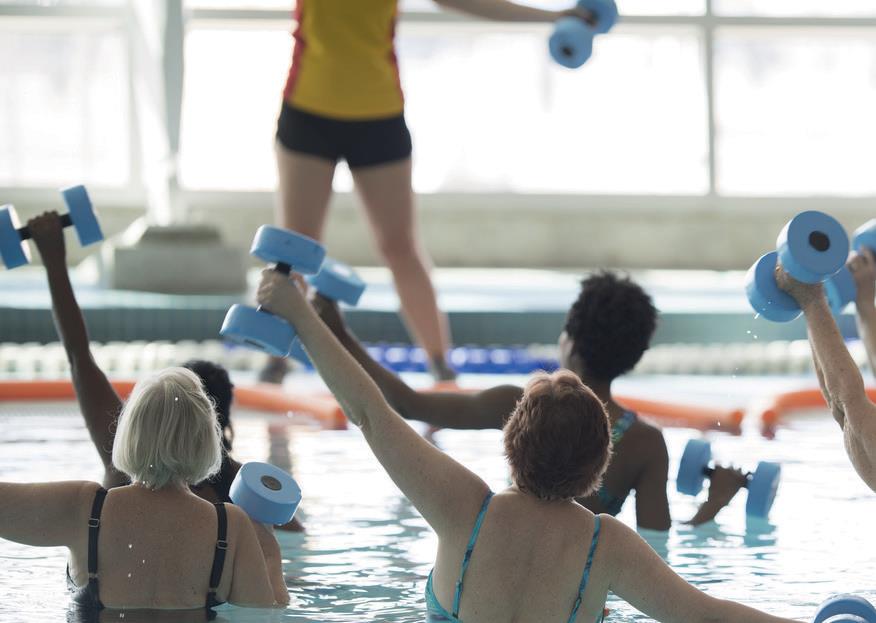
Healthy ageing is one of the clearest areas of opportunity. For many older adults, a pool provides an environment in which they can remain active when land-based exercise becomes difficult. Water can support people living with arthritis, reduced mobility, Parkinson’s, chronic pain or recovering from injury.
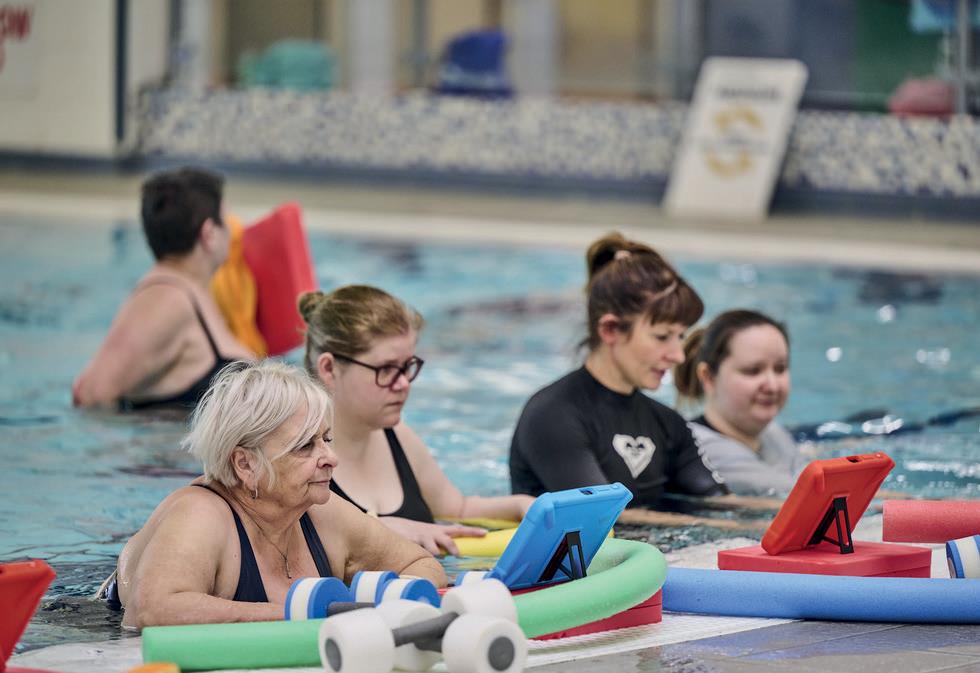 The benefits can also extend beyond physical activity. Regular daytime sessions can create relationships, routines and wider community connections. Aquatic exercise therefore has potential as part of preventative health, but delivering it effectively requires appropriately trained professionals.
Haylley Pittam-Park, director of education at the Aquatic Rehabilitation and Exercise Academy (A.R.E.A), argues that instructors need evidence-based knowledge, practical skills and the confidence to adapt exercises safely for increasingly complex participant needs.
“People often ask me why I’m so passionate about aquatic rehabilitation and exercise,” Pittam-Park says. “The answer is simple.”
She describes seeing people arrive poolside using walkers, crutches and sticks before entering the water and discovering they can move in ways they have not been able to for months or years.
For operators, that underlines the connection between facility investment and workforce development. A modern pool can only deliver its full social value when the people operating and programming it have the skills to do so.
WATER QUALITY
For all the focus on wellness, technology and programming, the fundamentals of pool operation remain critical.
Colin Day, sales manager at Lovibond®, argues that accurate water analysis should be regarded as the foundation of a positive swimming experience rather than simply a compliance exercise. Operators must balance regulatory requirements and public health responsibilities with rising operating costs, chemical management and customer expectations.
The private health-club market is demonstrating how swimming can sit within a broader wellness proposition.
At Third Space, wellness is considered at the beginning of the design process. Chris Stanton describes a model connecting training, recovery, nutrition, relaxation and wellness.
 Its clubs incorporate pools, hydrotherapy, Finnish saunas, steam rooms, loungers and ice baths alongside recovery zones featuring compression technology, Hyperice equipment, massage guns and vibration therapies.
Recovery itself is becoming a commercial proposition. Third Space has launched a formal recovery membership offering unlimited monthly access to recovery technologies and treatments including cryotherapy, red-light therapy, myofascial release and vibro-acoustic therapy at Canary Wharf, Chelsea, The Whiteley and Paternoster Square. For Stanton, changing consumer interest in sleep, stress, recovery, longevity and preventative health creates an opportunity to connect activities rather than treat them as separate services.
Andy Farr of Parkwood Leisure describes a “quiet revolution” in the use of data. Historically, operators concentrated on turnstile entries and throughput. Increasingly, they want to understand customer journeys, behaviours, values and backgrounds.
The question is no longer simply how many people used the pool, but who did not, why they did not and what might change the opportunity or motivation to participate. Combining participation data with customer and non-customer feedback and local demographic information can help operators make more defensible investment decisions. Whether the choice is refurbishing a pool, introducing concessionary pricing or launching an MSK rehabilitation service, the potential return can be considered financially and in terms of community wellbeing.
Commercial viability remains essential, but Farr argues that operators should also monitor retention, demographic reach, health outcomes and social value. Shared benchmarking could strengthen that process. Farr points to Sport England’s Moving Communities platform as an example of progress towards shared sector intelligence.
Artificial intelligence and predictive analytics could extend the approach over the coming decade, using participation, occupancy, customer behaviour and capacity data to support forecasting. The objective, however, remains better human decision-making. The objective is not simply to fill every available minute, but to identify genuine capacity and match it with community need and sustainable activity. Reliable information on swimmer numbers, occupancy, density, lane or zone use and safety-event history can provide the baseline. Local knowledge then determines the response. Operational intelligence extends to the building itself. In this year’s report,
Martin Killen, of Recotherm, highlights the energy demands of maintaining appropriate swimming-pool conditions. Traditionally, UK pools used 100% fresh-air ventilation. While effective in protecting buildings from condensation, this was highly energy intensive.
 Following the energy crisis of the 1970s, mechanical dehumidification became increasingly common. These systems recirculated pool-hall air through refrigeration circuits, cooling it to condense and remove moisture before reheating and returning it to the hall.
According to Killen, this reduced operating costs by around 60% compared with traditional full fresh-air systems, although efficient operation required systems to minimise fresh-air intake.
The principle is increasingly important as energy remains a major component of swimming-pool economics: buildings should not necessarily consume energy at maximum rates when demand is low. No assessment of swimming’s future can ignore the workforce. Lifeguards, swimming teachers, instructors, managers, engineers and front-of- house teams ultimately determine how effectively physical assets operate. Looking towards 2036, success should be measured by more than the number of children achieving 25 metres.
It should also encompass whether children in different communities have the opportunity to develop confidence in water and establish a relationship with swimming that can continue throughout life.
WATER SAFETY
The relationship between swimming and safety remains fundamental. Simmy Akhtar, chief executive officer of the Royal Life Saving Society UK (RLSS UK), describes water safety as a national public-health issue rather than a niche concern.
“We award 97% of all pool lifeguard qualifications in England,” Akhtar says, “and behind that figure are thousands of trained individuals standing poolside, ready to act in the moments that matter most.”
Prevention is central. The UK’s relationship with water extends beyond swimming pools to rivers, reservoirs, canals, coastlines and domestic environments. Open-water and coastal incidents reinforce the risks associated with unfamiliar environments and changing conditions.
For Akhtar, drowning is preventable, and swimming-pool operators are important partners in prevention. Pools provide supervised environments in which people can develop swimming ability, water confidence and safety knowledge. As outdoor swimming grows, that role becomes increasingly important.