Common mistakes and how to avoid them…
The plant room is the heart of the pool system where poor planning will lead to inefficiency, maintenance headaches and premature equipment failure. Today’s blue riband products for a modern, future-proof plant room are those that deliver maximum energy savings, superior water quality, and remote connectivity.

Eco-efficiency is no longer a luxury; it is the most crucial factor in pool design for 2026 and beyond. Rising energy costs, combined with client demand for sustainability, make high-efficiency equipment a standard specification. Eco-Efficiency needs to be obviously transparent and measurable to win increased pool equipment sales. A modern pool should be designed to achieve the lowest possible running costs. This means minimising the Big Three energy drains: pumping, heating, and lighting. Investing in eco-efficiency significantly improves the total cost of ownership (TCO) for the client.
HOLISTIC SYSTEMS
“The shift towards smart, efficient, and remotely monitored plant rooms is accelerating,” says Ocea UK’s Alan Thorne. “The successful pool specialist of 2026 will be the one who adopts a holistic systems approach. “Don’t view equipment as isolated components; understand how the variable speed pump flow rate impacts the heater efficiency, which impacts the chemical dosage, and how it’s all governed by the automation controller,” he continues. “This integrated thinking is key to delivering the long-term, low-cost, and sustainable solutions that clients demand today.
 “Our business is built on partnership, not just transactions. We offer a tiered support system designed to elevate the expertise and efficiency of the pool specialist,” Alan declares. “This difference means fewer costly call-backs, faster, more professional installations, and greater customer satisfaction stemming from optimal equipment performance and chemistry control. He adds: “For any installation or upgrade project, a structured approach is essential.”
Simon Ward from AES agrees: “Lack of planning usually leads to mistakes, we always talk about the long-term vision, so when planning a plant room layout we can incorporate future additions, this process is key before commencing with any installation, for example if pipework is too close it makes simple modifications in the future difficult without undertaking large pipework changes.”
AES use its field engineer app-based system called Klipboard which allows design workflows to ensure works are completed to the correct standard and within the specified timescale, this system also ensures all commissioning checks are carried out and the customer receives a certificated record of works.
With all swimming pools the ongoing running cost is a massive consideration, at AES we make sure we consider the most efficient products based on what the customer is trying to achieve, this consideration covers both electrical and water consumption, with cloud controlled products (for example Poolex Cloud) it makes it possible for multiple products in the plant room to talk to each other which then leads to further efficiencies. Most customers are aware of how much it costs to run/heat their pool so it is usually quite easy to demonstrate a saving by upgrading a pump or switching to an Inverter heat pump.
 It is widely acknowledged that an air source heat pump is a great way to heat a swimming pool but we cannot take that one step further as we start to see new air source heat pumps that can optimise their running in alignment with renewables like solar, wind, battery storage and dynamic energy tariffs. This is a game changer that will allow customers to achieve real savings on what is normally one of the largest pool running costs.
For customers who have solar panels and would like to fully harness that ‘free’ energy, the Poolex Jet Pro is compatible with ESS (energy storage systems) for easy connection to solar panel systems and Smart Grid technologies for dynamic energy management and grid optimisation AES provides technical support for its complete range of products, but also have many years of experience with other branded products to provide pros and cons when talking to clients about upgrading their products and plant rooms.
“We understand the importance of ongoing support,” says Simon. “Because many customers work for themselves, a lot of the questions we receive about installation or operation takes place outside normal 9 to 5. “We have built a reputation based on our ability and willingness to be available to customers whenever we are needed, anyone can sell a product, but we understand it’s customer service that really matters,” Simon adds.
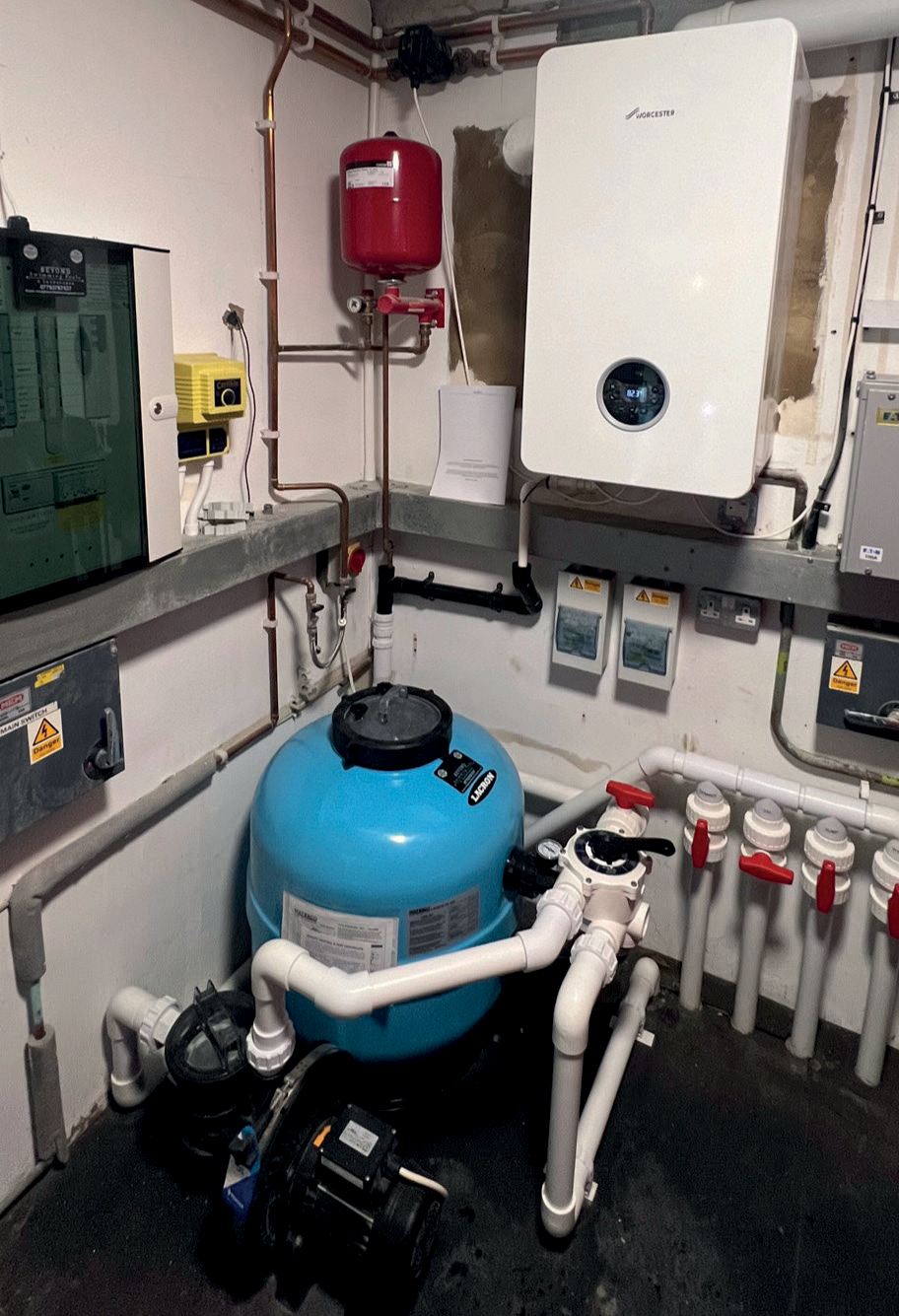 Both the domestic and commercial pool markets now have a huge choice of products that will drop into new or old filtration systems instantly giving many advantages in performance and economy. These include either purpose made variable speed pumps or standard pumps controlled by a variable speed drive (VSD).
These VSDs have been used in large commercial systems for many years but are now available as a cost-effective unit compatible with the pumps used on domestic spas and swimming pools.
HALVE COSTS
“The main reason for switching to a VSP is its energy efficiency,” points out Plastica’s Will Dando. “This benefit is rooted in the Pump Affinity Law, a hydraulic principle stating that the power required to run a pump is proportional to the cube of the speed. In simple terms, if you cut the pump’s speed by half, the power consumption is reduced to one-eighth,” Will continues. “Since pools only need maximum speed for tasks like backwashing or running a swim jet, a VSP can run at a much lower, more efficient speed for day-to-day filtration. Traditional single-speed pumps typically draw between 1kW and 2kW, while a VSP can maintain adequate flow using as little as 300 watts. The high efficiency makes the VSP an investment that often pays for itself in less than two years through utility cost reduction.
 Another benefit is that slower water flow results in better filtration. When water rushes through the filter media at high speed, it can force fine debris and suspended particulates straight through. A lower speed for longer periods ensures the water passes through the filter more gently and slowly resulting in significantly clearer water.
A standard single-speed pump running at around 2800 RPMs can be 65-90 decibels, while a VSP operating at a low filtration speed, typically registers around 30-45 decibels. This quiet operation is a welcome change for pool owners and their neighbours. VSPs also offer greater durability and a longer lifespan. By not constantly running at maximum RPM, the motor experiences less stress and heat build-up, which is a primary factor in pump failure.
Will concludes: “Many of these products have smart technology built in to make them very user friendly and are all ready to run to a schedule or perform a backwash at the touch of a button.”