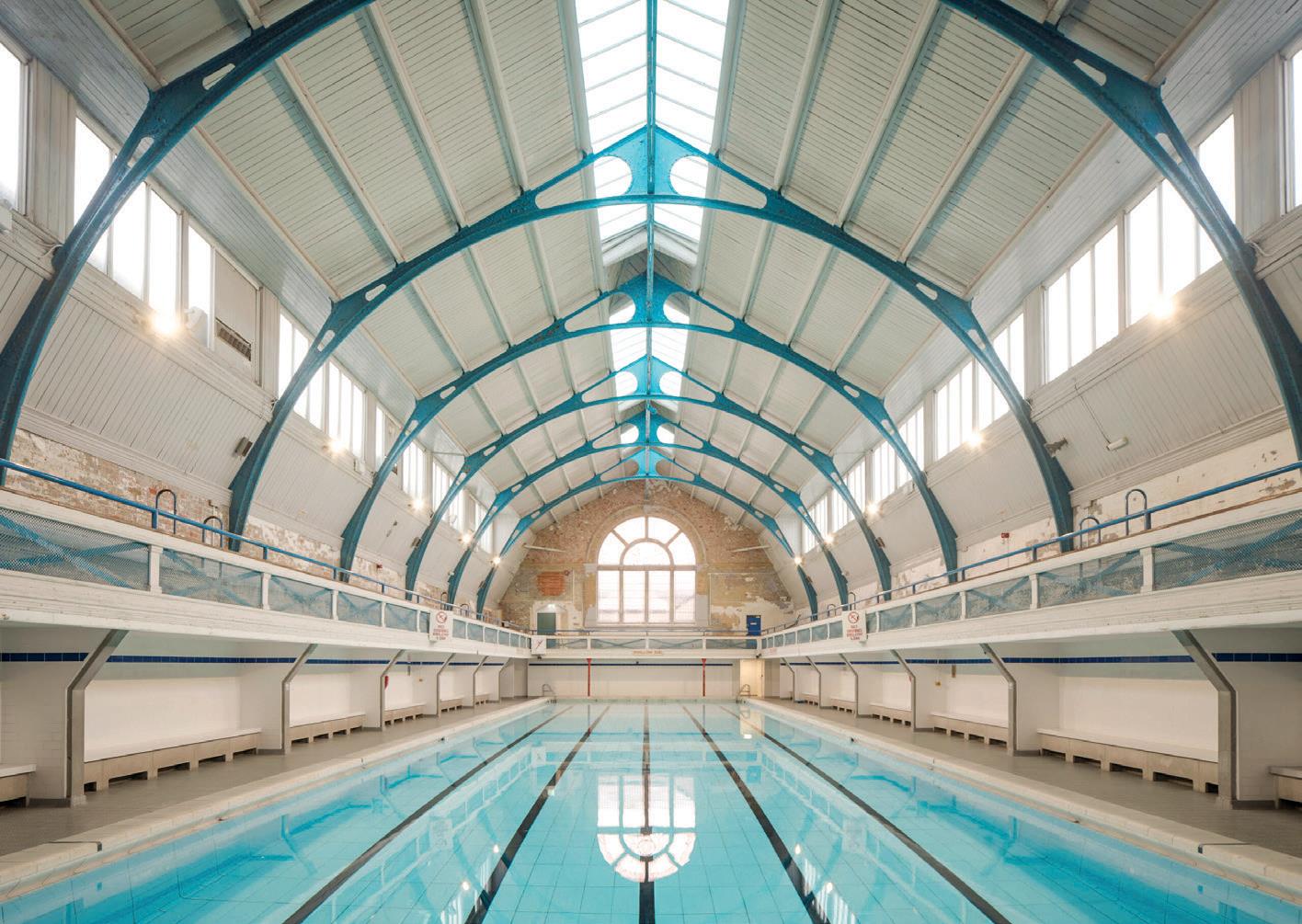
 Recently marking its 10th anniversary, Historic Pools of Britain (HPB) shines a spotlight on the nation’s much-loved swimming heritage — raising awareness, championing campaigns, and uniting communities. One of HPB’s greatest strengths lies in the connections it forges between community groups, campaigners, pool operators, heritage experts, and passionate individuals across the UK.
These relationships have enabled knowledge-sharing, moral support, and collective action. Recent successes include Swindon’s Health Hydro that reopened in January, following the completion of the first phase of major restoration works. The longest continually operating Victorian-style Turkish Baths in the UK, it features an exposed timber roof structure and glazed brickwork walls, including moulded cornices, dado rails, and skirtings, as well as a terrazzo floor.
As perhaps one of the earliest experiments in socialised healthcare, the Health Hydro inspired the architects of the NHS, who visited Swindon after World War II. Built by the Great Western Railway Medical Fund Society in 1891, the Health Hydro, as it is now known, sought to provide affordable access to both preventative and medical care. It was funded by subscriptions from GWR employees, who recognised that good health is not just the absence of disease, but a process influenced by hygiene, diet, environment, physical activity, and community support.
The impressive Queen Anne-style building extends over a whole block. Its materials (metal roof trusses, red bricks, and external and internal joinery, etc.) were produced almost entirely within the GWR Works.
COMMUNITY FACILITIES
 Two Victorian swimming pools sit alongside a complete and pioneering medical service, including consulting rooms for doctors and dentists, as well as ophthalmology, chiropody, psychology, and physiotherapy services, a dispensary, and an X-ray room.
Further phases are being planned to restore the Victorian splendour of the Health Hydro, realise its vision, and “give a contemporary expression to its original ethos and intent.”
Meanwhile, Birmingham’s Moseley Road Baths has appointed a main contractor, Galliford Try, to work on Phase One of the building programme, which is set to complete in 2027.
While the building team is focusing on work that includes replacing the steel beam in the basement, reconfiguring visitor spaces, and installing renewable energy systems, the fundraising team has been just as busy as they seek to close the funding gap for Phase Two. They have also been working with a muralist to design and install a striking mural, bringing colour and vibrancy to the exterior of the building.
The Phase One works at Moseley Road Baths have been funded by the UK Government, Birmingham City Council, and The National Lottery Heritage Fund.